
The Hidden Access Tax on Global Expansion: Why Payments Infrastructure Isn't the Problem
Global payments infrastructure has never been more advanced.
Real-time payment networks are expanding. Local payment rails are increasingly digital.
Cross-border payments are becoming faster. APIs have transformed how financial services are integrated into products.
And yet, for many businesses, launching financial operations in a new market can still take months.
The problem is often not that the infrastructure does not exist. It is that accessing that infrastructure remains fragmented.
A company expanding into a new country may need a new banking relationship, another compliance review, additional contracts, local payment integrations, operational processes, and potentially new regulatory considerations before it can process its first transaction.
Then it enters another market - and much of the process starts again.
This creates what we think of as the hidden access tax on global expansion: the time, operational complexity, and opportunity cost businesses absorb simply to connect to financial infrastructure that already exists.
For fintech platforms, marketplaces, payment companies, and global enterprises, reducing that access tax can fundamentally change how quickly they move money globally and expand into new markets.
The Payments Infrastructure Already Exists. Access Is the Bottleneck.
Moving money internationally is often discussed as an infrastructure problem.
But the underlying rails are already there.
The United States has ACH, Fedwire and other payment networks. Europe has SEPA and SEPA Instant. The UK has Faster Payments. Brazil has Pix. Other markets have their own domestic banking and payment infrastructure.
The challenge for an international business is connecting all of those systems into one operational model.
Traditionally, entering a new market can mean establishing new banking relationships, negotiating contracts, completing compliance and risk assessments, integrating another technical provider, and building processes around reconciliation, settlement and reporting.
None of those steps is unusual on its own.
The problem is what happens when they are repeated market after market.
A payment stack that works efficiently in one country can quickly become a collection of disconnected relationships, integrations and workflows as the business expands.
That fragmentation becomes infrastructure debt.
And infrastructure debt slows growth.
Every Month Waiting Is a Market You're Not Live In
The cost of delayed financial access is easy to underestimate because much of it looks like administrative work.
A banking application is pending. Compliance is reviewing the structure. Contracts are being negotiated. An integration is waiting for approval.
But while those processes are happening, the commercial opportunity does not stop.
Customers are still transacting. Payment volume is still moving. Competitors with existing access can continue acquiring customers and building relationships.
That means delayed access is not simply a paperwork problem.
It can mean lost revenue, slower time-to-market and delayed product expansion.
For a company entering one market, several months may be manageable. For a company trying to operate across the US, Europe, LATAM, Asia and other regions, repeating that process independently can become a fundamental constraint on global growth.
The question therefore changes from: Does this market have the payment infrastructure we need? to: How quickly can we access it?
Why Cross-Border Payments Still Feel Market by Market
Global expansion creates complexity at several layers simultaneously.
There is the banking layer: where funds are collected, held, moved and settled. There is the payments layer: which local rails and payment methods need to be supported. There is the compliance layer: KYC, AML, sanctions screening and the controls required for the relevant flow. And there is the technology layer: APIs, reporting, reconciliation and operational tooling.
When these layers are sourced independently in every market, businesses can end up maintaining a growing network of providers and integrations.
Market A has one banking partner. Market B requires another. Market C introduces a different local payment method. Market D requires a new integration and compliance process.
The company may technically have global coverage, but operationally it is managing a series of local payment stacks.
This is exactly the type of fragmentation that global payments infrastructure should reduce.
What 'No Direct Bank Relationship Required' Actually Means
Simplifying banking access does not mean removing banks or regulated financial institutions from the payment ecosystem.
They remain fundamental.
Banks, payment institutions, licensed partners and local infrastructure providers operate the accounts and rails that allow money to move safely and compliantly around the world.
The opportunity is to change how businesses access that ecosystem.
Instead of requiring a company to independently establish and manage a new direct banking relationship for every market it enters, a payments infrastructure platform can provide a unified access layer connecting the business to established banking and payment infrastructure.
That distinction matters. The objective is not to eliminate the institutions behind the financial system. It is to eliminate unnecessary fragmentation for the business using it.
With RidgeX, businesses can connect through one API and access supported local account and payment infrastructure without having to independently build every underlying relationship from scratch.
The banks and regulated partners remain essential parts of the infrastructure.
RidgeX simplifies the layer between that infrastructure and the businesses that need to use it.
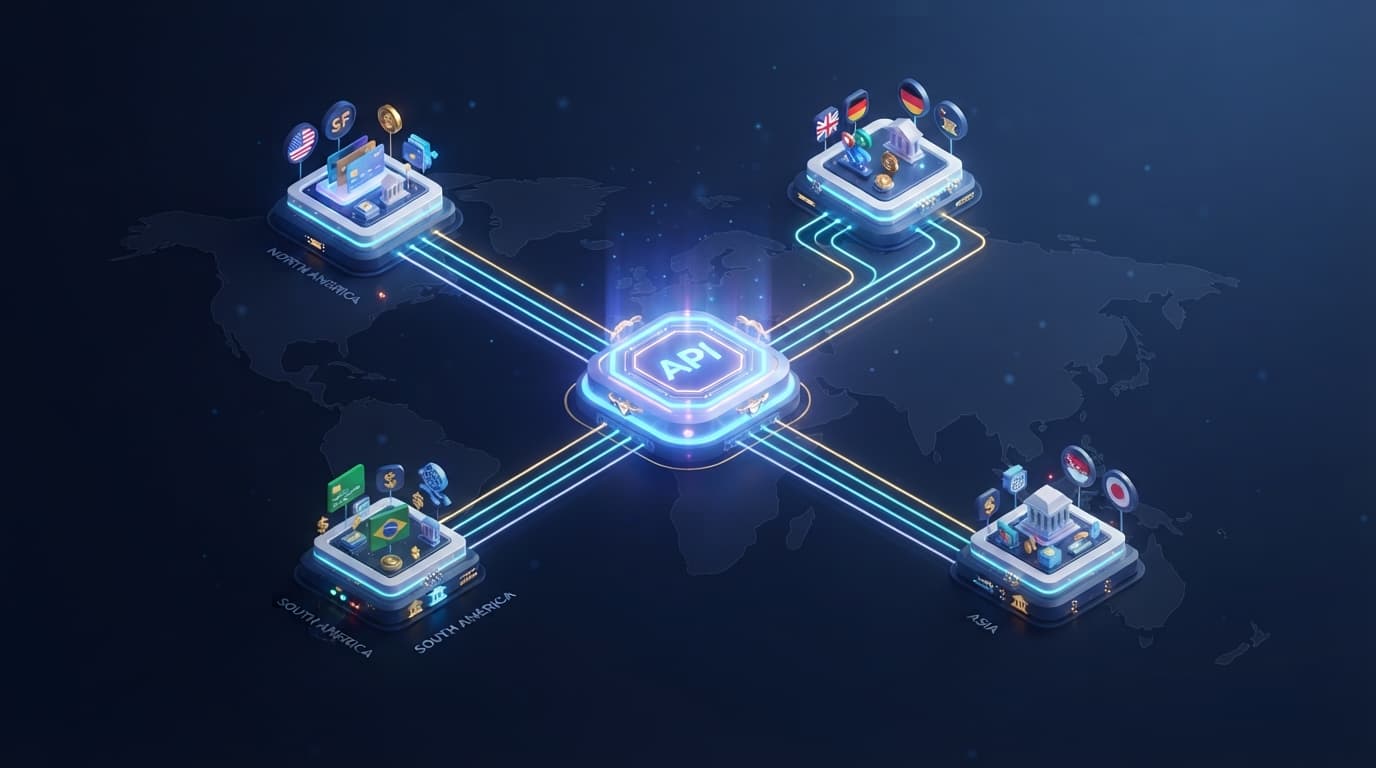
One API. One Integration. Multiple Markets.
The traditional model of international expansion creates a relatively simple equation: More markets = more integrations + more relationships + more operational complexity.
That equation does not scale particularly well.
A better infrastructure model separates the company's product from the complexity underneath it.
Rather than integrating independently with each component of the payment chain, businesses connect once to a payments infrastructure layer capable of orchestrating access across supported markets.
For RidgeX, that means bringing together Global Accounts, local payment rails, cross-border payments and compliance built into one API - giving businesses one integration to move money globally across supported markets.
The business integrates with RidgeX. RidgeX connects that integration to the relevant infrastructure and partners behind each supported market.
As coverage expands, the customer should not have to rebuild its financial architecture every time. That is the difference between simply having access to payment infrastructure and having programmable global access to it.
Global Accounts and Local Rails: From Months to Days
Speed matters because financial infrastructure sits directly on the critical path of expansion.
A marketplace cannot fully launch payments without the ability to collect and settle funds. A fintech cannot serve customers in a market without the relevant account and payment capabilities. An enterprise expanding internationally needs reliable ways to collect, move and reconcile money.
If accessing those capabilities takes months in every market, financial infrastructure determines the speed at which the business itself can expand.
RidgeX is designed to compress that process.
Through one integration, businesses can access Global Accounts, local accounts and payment capabilities across supported markets without independently rebuilding their banking and payment stack each time.
The goal is straightforward: Turn financial access from a market-entry project into infrastructure that is already available when the business needs it.
That can turn a process measured in months into one measured in days, depending on the market, use case and applicable onboarding and compliance requirements. Importantly, faster access does not mean bypassing compliance.
It means having compliance built in to the infrastructure rather than treating it as another disconnected process that needs to be reconstructed market by market.
A Simpler Way to Move Money Globally
The financial system is inherently local.
Different markets have different currencies, payment rails, banks, regulations and operating requirements. That is unlikely to disappear - nor should it.
What can change is how much of that complexity businesses need to manage themselves.
Global payments infrastructure should absorb the fragmentation underneath and give businesses a simpler way to move money globally through one integration.
The infrastructure behind the scenes can remain sophisticated - banking partners, payment networks, compliance systems and local rails all working together.
But the experience for the company building on top of it should not require reconstructing that network country by country.
That is the access problem RidgeX is solving.
The rails already exist.
Global businesses should be able to access them without spending months rebuilding the path to them.
Ready to Enter Your Next Market?
Talk to RidgeX to see how one API can give your business access to Global Accounts, local accounts, cross-border payments and local payment infrastructure across supported markets - without establishing a new direct banking relationship in every country.